
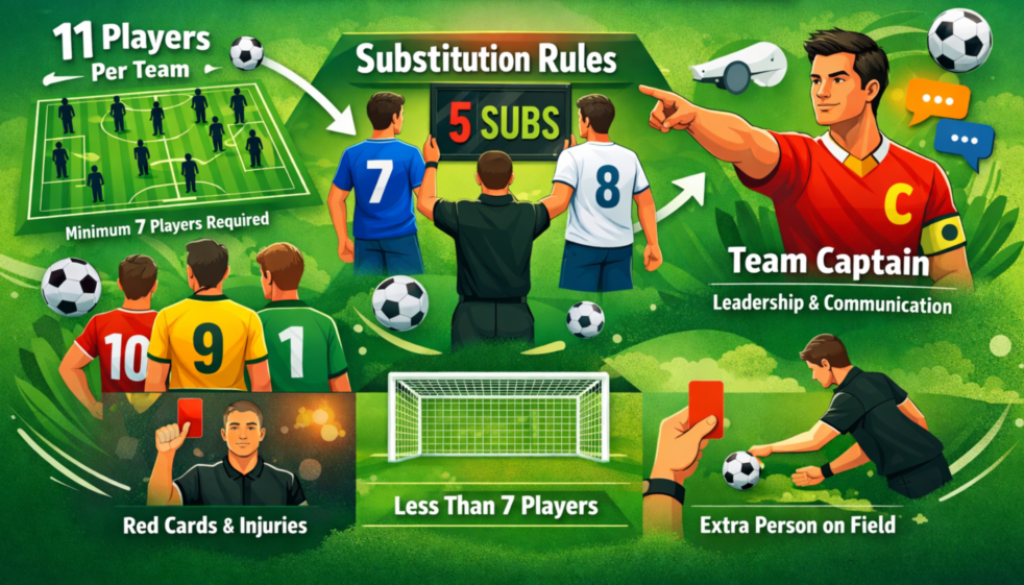
Football Laws of the Game: Player Numbers, Substitution Rules, and Captain Responsibilities
1. Number of Players in Football
A football match is played between two teams, each with a maximum of 11 players, including one goalkeeper.
Minimum number of players
- A football match is only valid if both teams have at least seven players on the field; otherwise, the match cannot begin or must be stopped.
- If a player deliberately leaves the field and reduces the team to fewer than 7 players, the referee allows play to continue until the ball goes out of play.
- Once the ball is out of play, the match must not restart if the team has fewer than 7 players.
Player list requirements
- All players and substitutes must be named before kickoff.
- Only players listed on the team sheet can participate in the match.
- A team may start with fewer than 11 players, but only listed substitutes can enter later.
2. Number of Substitutions Allowed
According to FIFA and IFAB rules:
- Each team is allowed a maximum of 5 substitutions in official competitions.
- These substitutions can be made during 3 substitution opportunities, excluding halftime.
Important substitution rules
- Multiple substitutions made at the same stoppage count as one substitution opportunity.
- If both teams substitute at the same time, it counts as an opportunity for both teams.
- Substitutions performed during halftime are not included in the total number of substitution opportunities.
Extra time substitutions
- In matches with extra time, teams may receive one additional substitution.
- Any unused substitutions from regular time can still be used in extra time.
Exceptions in some competitions
More substitutions may be allowed if:
- Both teams agree before the match, and
- The referee is informed before kickoff.
If the referee is not informed, only the standard substitution limit applies.
3. Return Substitutions
Return substitutions are allowed only in specific categories:
- Youth football
- Veteran football
- Disability football
- Grassroots football
This must be approved by the national football association, confederation, or FIFA.
4. Concussion Substitution Rule
Competitions may allow additional concussion substitutions to protect player safety.
Key points:
- Concussion substitutions are permanent.
- If one team uses a concussion substitute, the opposing team also gets an additional substitution opportunity.
5. Substitution Procedure
The correct substitution procedure must be followed:
- The referee must be informed before any substitution.
- The substitute enters only during a stoppage in play.
- The substitute enters from the halfway line.
- The substituted player must exit the field before the replacement player is allowed to enter.
- The substitute can enter only after receiving the referee’s signal.
- All substitutes are under the referee’s authority, whether they play or not.
If a substituted player refuses to leave, play continues until the next stoppage.
6. Goalkeeper Substitution Rules
Any outfield player can change places with the goalkeeper if:
- The referee is informed before the change, and
- The switch can only take place when the match is temporarily stopped.
7. Extra Persons on the Field of Play
The following individuals are not considered players:
- Team officials (coach, assistant coach)
- Substitutes
- Sent-off players
- Outside agents (spectators, animals, etc.)
If an extra person enters the field:
The referee must:
- Stop play only if there is interference
- Remove the extra person
- Take disciplinary action if required
Restart decisions
- Outside agent interference → Dropped ball
- Team official or substitute interference → Free kick or penalty kick
If the ball enters the goal and interference did not prevent defenders from playing the ball, the goal is awarded.
8. Team Captain Role and Responsibilities
Each team must have a captain, identified by an armband.
The captain:
- Has no special privileges under the Laws of the Game
- Is responsible for team discipline and behaviour
- Represents the team in communication with the referee
- Helps organize team tactics on the field
Conclusion
Understanding the football laws regarding players and substitutions is essential for ensuring fair play and proper match management. Each team must start with a maximum of 11 players and cannot continue with fewer than 7 players. The substitution system allows teams to adjust tactics, manage player fatigue, and respond to injuries while following strict procedures defined by IFAB and FIFA.
Rules such as substitution limits, concussion substitutions, goalkeeper changes, and handling extra persons on the field ensure player safety and maintain the integrity of the game. Additionally, the team captain plays an important leadership role in maintaining discipline and communication.
These laws form the foundation of modern football and are applied consistently across professional, amateur, and international competitions worldwide.
Frequently Asked Questions (FAQ)
How many players are allowed in a football match?
Each team is allowed a maximum of 11 players, including one goalkeeper. A football match requires at least seven players on each team; otherwise, it cannot begin or continue.
How many substitutions are allowed in football?
In official competitions, each team is allowed 5 substitutions. These must be made within 3 substitution opportunities, excluding halftime.
Are substitutions allowed during halftime?
Yes. Substitutions made during halftime do not count toward the substitution opportunity limit.
Can a substituted player return to the match?
Return substitutions are only allowed in youth, veteran, disability, and grassroots football, depending on competition rules.
In professional football, substituted players cannot return.
Can any player become the goalkeeper?
Yes. Any outfield player can change places with the goalkeeper if the referee is informed and the change is made during a stoppage in play.
What happens when a team drops below the minimum requirement of seven players?
The match cannot start or continue if a team has fewer than 7 players. The referee must stop the match.
What happens if an extra person enters the field?
If an outside person interferes with play, the referee stops the match and restarts with a dropped ball.
If a substitute or team official interferes, the referee may award a free kick or penalty kick.
Does the team captain have special powers?
No. The team captain has no special privileges under the Laws of the Game, but is responsible for team discipline and communication with the referee.