

IPL Powerplay Analysis (2008–2025): Teams, Trends, and the Most Dangerous Batters
Introduction
In T20 cricket, the first six overs—known as the Powerplay—are one of the most important phases of an innings. During this period, only two fielders are allowed outside the 30-yard circle, creating a unique balance between aggressive batting and attacking bowling.
Because of these field restrictions, teams often try to maximize scoring opportunities early in the innings. However, the Powerplay also exposes batters to the new ball, which can lead to early wickets.
Over the years, the Indian Premier League (IPL) has seen a significant evolution in how teams approach the Powerplay. Modern teams are far more aggressive compared to the early seasons of the tournament.
In this analysis, we explore IPL Powerplay data from 2008 to 2025, examining:
- How Powerplay scoring trends have evolved
- Which teams dominate the Powerplay
- When wickets fall most frequently
- Which batters are the most explosive during the first six overs
This data-driven approach helps us understand how Powerplay strategies have changed in modern T20 cricket.
Powerplay Scoring Trend in IPL (2008–2025)
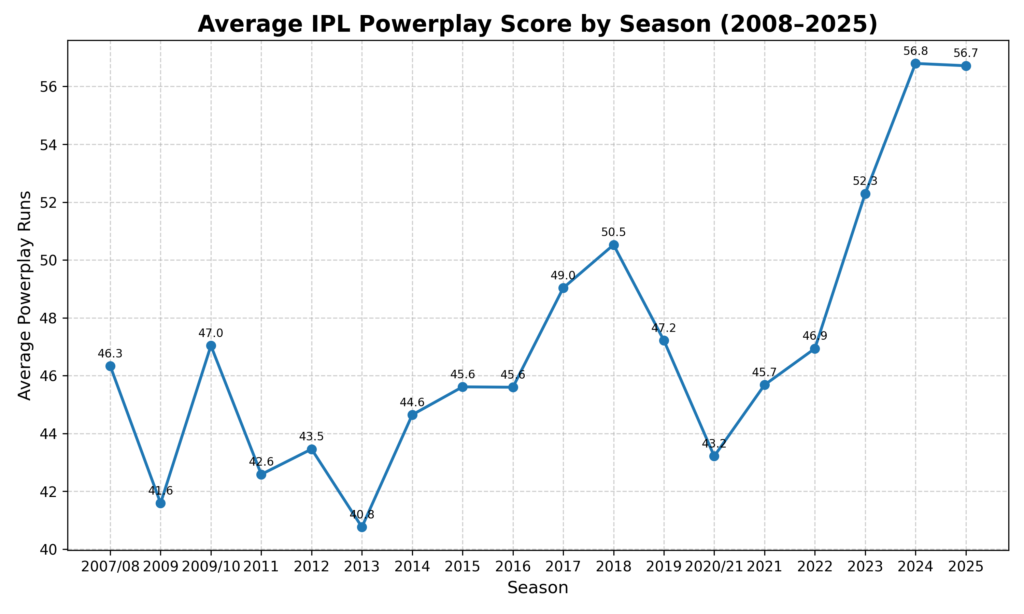
The chart shows how average Powerplay scores in the IPL have evolved.
During the early years of the IPL, teams generally adopted a cautious approach in the first six overs. Between 2008 and 2013, the average Powerplay score mostly ranged between 41 and 47 runs, with the lowest point occurring in 2013 when the average dropped to around 40.8 runs.
At that time, T20 strategies were still developing. Many teams preferred to preserve wickets rather than attack aggressively, ensuring stability for the middle and death overs.
However, the approach to Powerplay batting began to change in later seasons.
From 2017 onward, the average Powerplay score started to increase steadily. The average crossed 50 runs in 2018, and by 2023 it exceeded 52 runs.
The most aggressive scoring is seen in 2024 and 2025, where the averages reach 56.8 and 56.7 runs, respectively.
This rise reflects the evolution of modern T20 batting strategies, where teams aim to maximize scoring during field restrictions using aggressive openers and deep batting lineups.
IPL Powerplay Run Rate by Team
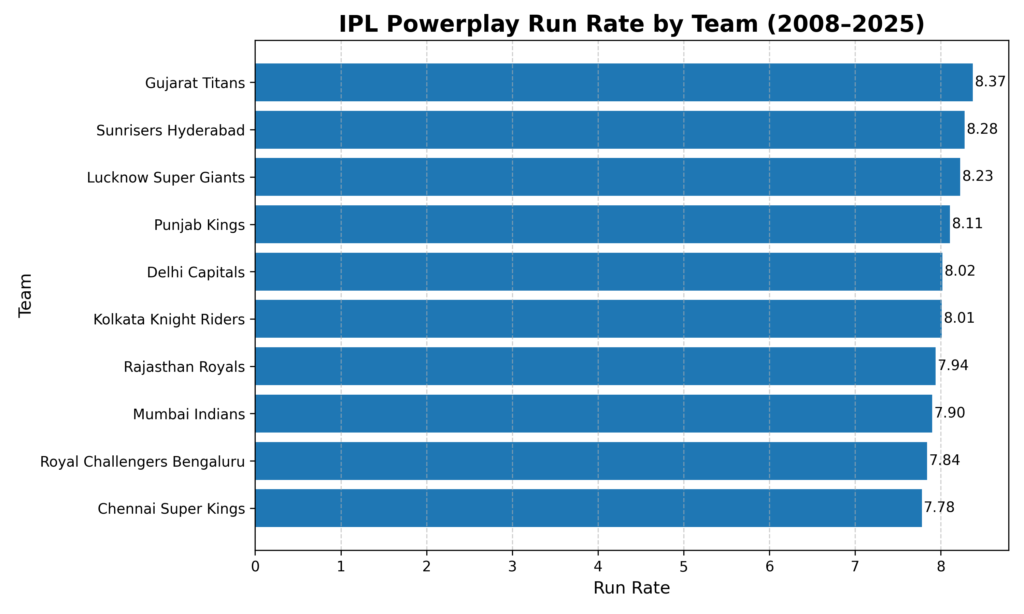
Although Powerplay scoring has increased across the IPL, some teams have been more efficient than others during the first six overs.
Teams such as Gujarat Titans, Sunrisers Hyderabad, and Lucknow Super Giants maintain Powerplay run rates above eight runs per over, indicating a highly aggressive batting approach.
These teams typically rely on:
- Explosive opening partnerships
- Early boundary hitting
- Taking advantage of fielding restrictions
On the other hand, teams with slightly lower Powerplay run rates often prefer a balanced strategy, focusing on minimizing early wickets before accelerating later in the innings.
Overall, Powerplay run rate often reflects a team’s batting philosophy and tactical approach to T20 cricket.
When Do Wickets Fall in the Powerplay?
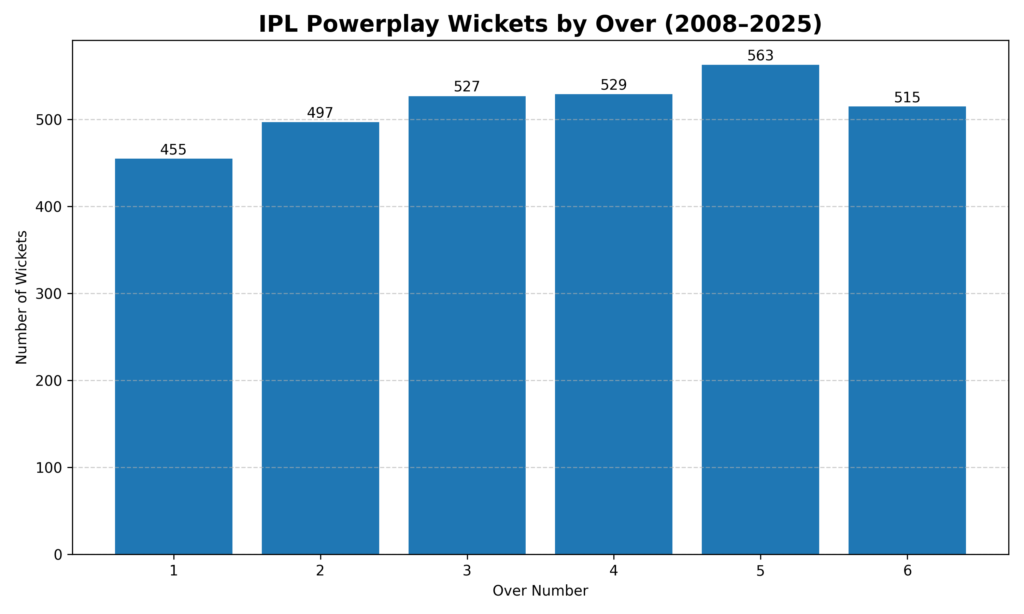
While the Powerplay favors batters due to field restrictions, it is also a phase where bowlers can exploit the new ball and attacking field placements.
The wicket distribution across Powerplay overs reveals a clear pattern.
In the first over, wickets are relatively rare because batters usually begin cautiously while assessing pitch conditions and bowling pace.
However, wicket frequency gradually increases in the middle overs of the Powerplay.
The highest wicket counts typically occur around overs four and five, when batters begin accelerating to maximize scoring before the field restrictions end.
This stage represents a high-risk, high-reward phase, where aggressive batting can produce quick runs but also increases the chances of dismissal.
Which IPL Teams Dominate the Powerplay?
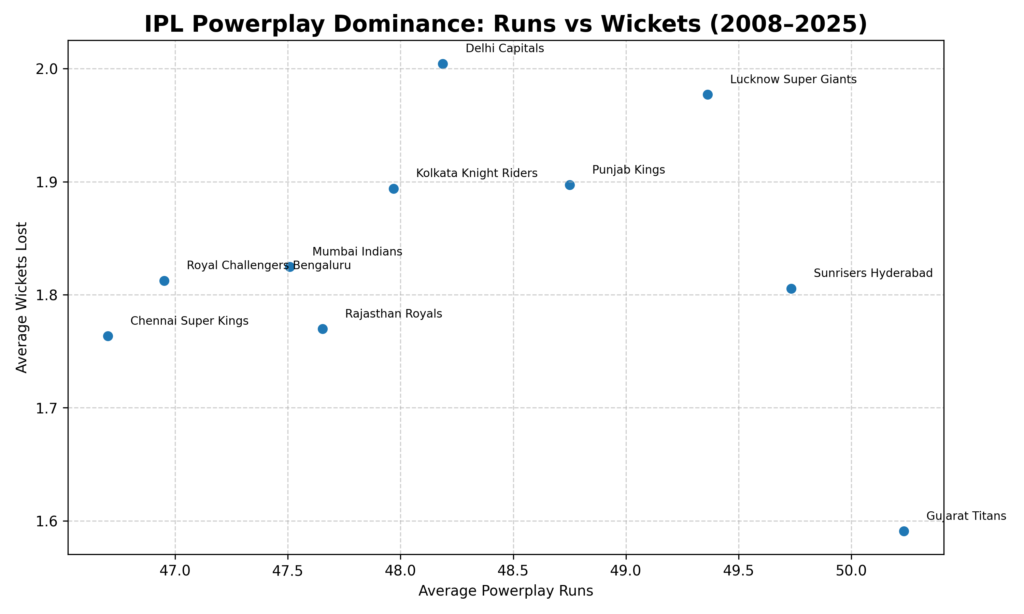
To understand team strategies more clearly, we can compare two important metrics:
- Average Powerplay runs scored
- Average wickets lost during the Powerplay
Teams that score high runs while losing fewer wickets occupy the most favorable position in this comparison. These teams manage to balance aggression with stability, which is ideal in T20 cricket.
Some teams appear with high run totals but also higher wicket counts, indicating a high-risk strategy focused on fast scoring.
Others lose fewer wickets but score more slowly, reflecting a more conservative Powerplay approach.
This comparison highlights the different tactical philosophies used by IPL franchises.
Most Aggressive Powerplay Batters in IPL
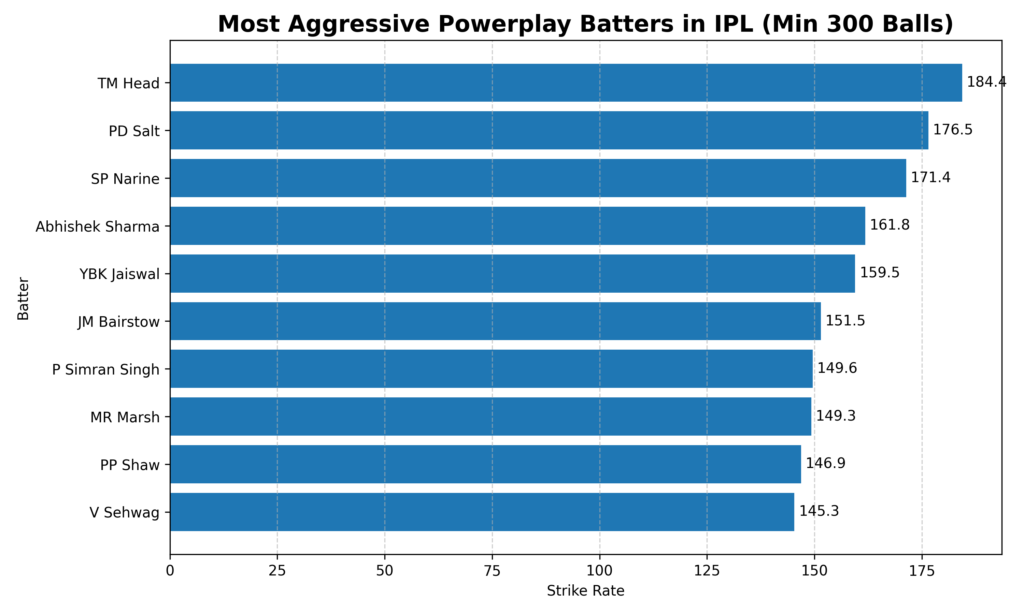
Individual players play a crucial role in shaping Powerplay outcomes.
Certain batters specialize in attacking during the first six overs when field restrictions create the most scoring opportunities.
The strike rate analysis highlights several modern IPL batters known for their aggressive Powerplay batting, including:
- Travis Head
- Phil Salt
- Abhishek Sharma
These players often attack from the very first ball, putting immediate pressure on bowlers.
Interestingly, Virender Sehwag also appears among the top Powerplay performers despite playing in earlier IPL seasons. This highlights how Sehwag was ahead of his time, adopting an ultra-aggressive approach long before it became common in modern T20 cricket.
Players with the Most Powerplay Runs in IPL
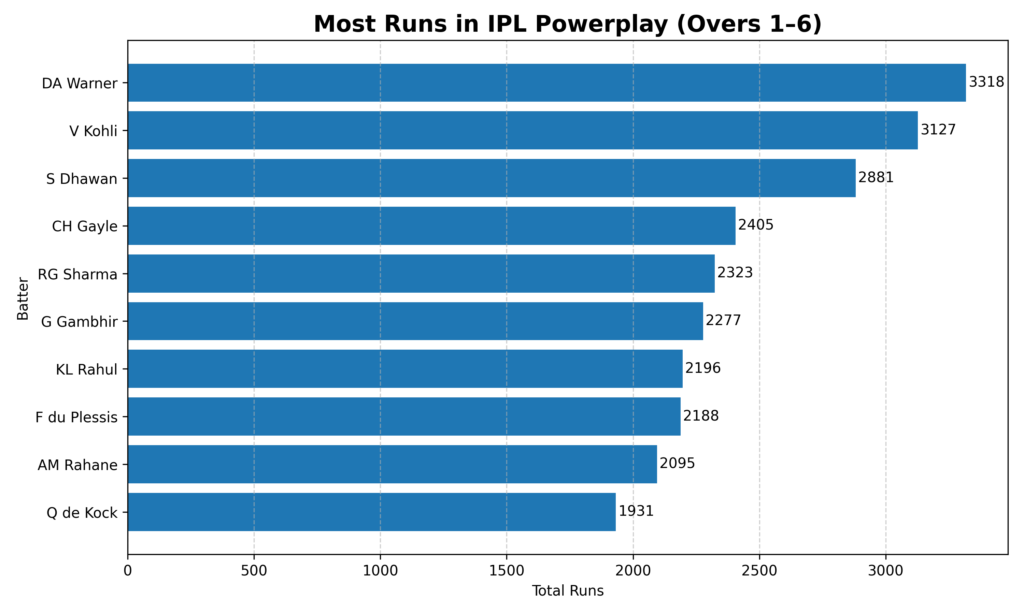
While strike rate measures aggression, total runs reveal long-term consistency and longevity.
Players who dominate this list are usually long-serving opening batters who consistently score during the Powerplay across many seasons.
Batters such as:
- David Warner
- Rohit Sharma
- Virat Kohli
have accumulated large Powerplay run totals due to their long careers and consistent performance at the top of the batting order.
This list highlights players who not only score quickly but also maintain sustained performance across multiple IPL seasons.
Conclusion
The Powerplay remains one of the most influential phases in T20 cricket, and IPL data clearly shows how strategies have evolved.
Key insights from the analysis include:
- Powerplay scoring has steadily increased across IPL seasons
- Teams now prioritize aggressive batting in the first six overs
- Wickets tend to fall more frequently in the middle and later overs of the Powerplay
- Some teams consistently maintain higher Powerplay run rates
- Modern T20 batters are significantly more aggressive than earlier generations
As the IPL continues to evolve, the importance of maximizing the Powerplay will only increase. Teams that successfully balance aggressive scoring with wicket preservation are most likely to gain an early advantage and build match-winning totals.