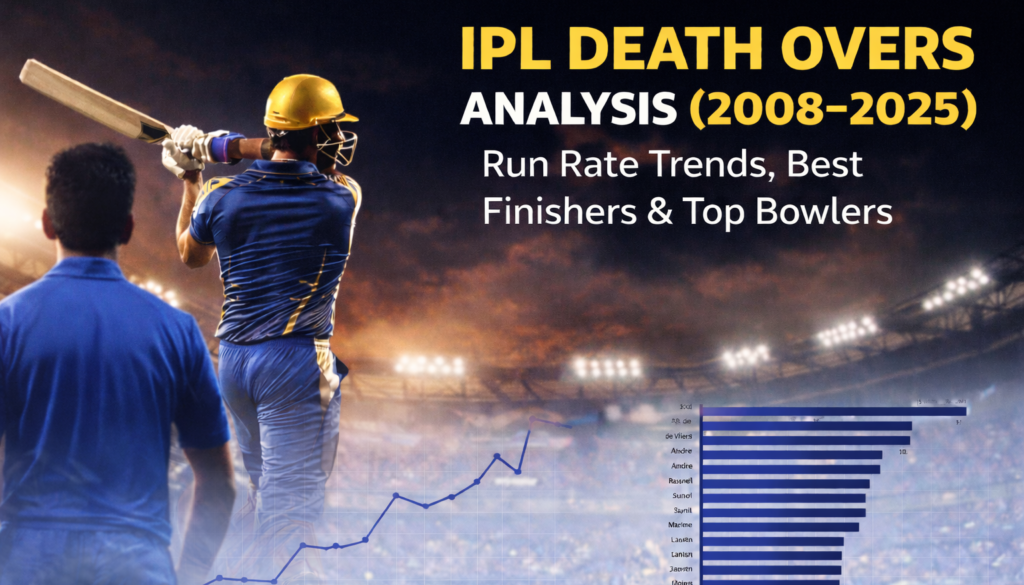
IPL Death Overs Analysis 2008 to 2025 Run Rate Trends Best Finishers and Top Bowlers
The Indian Premier League has always been known for its fast-paced and high-scoring nature, but if there is one phase that truly defines the outcome of a match, it is the death overs. These final five overs, from 16 to 20, are where the intensity of the game reaches its peak, where batters look to maximize every delivery and bowlers are pushed to their absolute limits. Over the years, this phase has transformed significantly, not just in terms of scoring but also in the way teams approach it strategically. What was once a controlled finish has now become an explosive endgame where momentum can shift in just a few deliveries.
In a typical T20 structure, the innings is divided into three phases, starting with the powerplay, moving into the middle overs, and finally ending with the death overs. While the powerplay sets the tone and the middle overs stabilize the innings, it is the death overs that ultimately decide the final score and often the result of the match. Teams now invest heavily in players who can either score quickly in these overs or control the damage with the ball. This growing importance has led to a noticeable evolution in both batting and bowling performances, which becomes very clear when we analyse the data from 2008 to 2025, as shown in the graphs and the dataset used in this study.
1. Evolution of Death Over Run Rate(2008 – 2025)
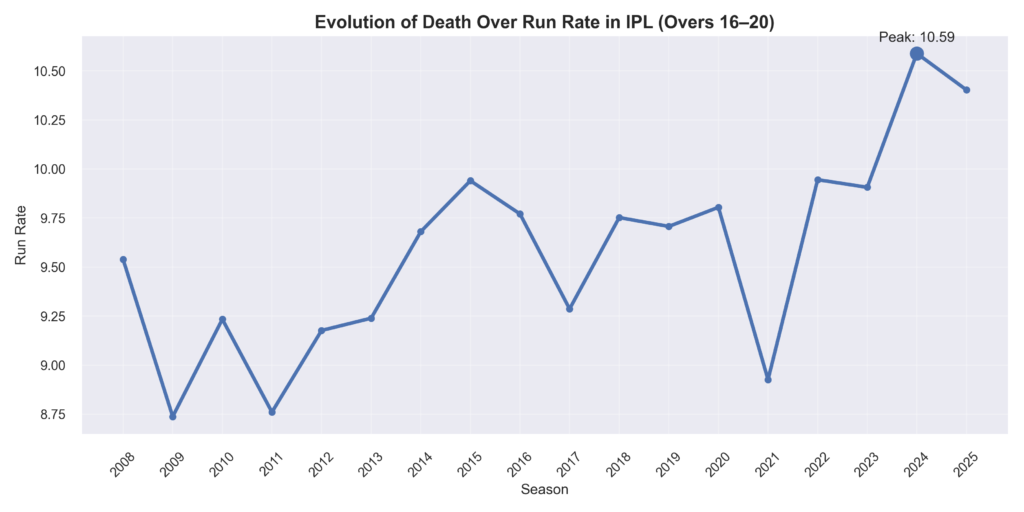
When we look at the evolution of death over run rate from 2008 to 2025, the graph clearly tells a story of transformation. In the early years of the IPL, especially between 2008 and 2012, teams approached the final overs more cautiously. The run rate during this period mostly remained between 8.7 and 9.5, which, by today’s standards, appears relatively moderate. Batters focused on maintaining wickets and building a steady finish rather than taking aggressive risks. However, as the tournament progressed, particularly from around 2013 onwards, there was a visible shift in approach. Teams began to adopt a more attacking mindset, supported by the emergence of powerful finishers and improved hitting techniques.
This change becomes even more evident in the later years, when the graph shows a steady rise in run rates, eventually crossing the 10 runs per over mark consistently. Despite a few dips, such as in 2009 and 2021, which may be attributed to pitch conditions or external factors, the overall trend continues upward. The peak comes in 2024, where the run rate reaches 10.59, the highest in IPL history. This clearly reflects how modern T20 cricket has evolved into a format where teams aim to extract maximum value from every delivery in the final overs. The death overs are no longer about finishing safely; they are now about finishing aggressively and dominating the opposition.
2. Best IPL Finishers in Death Overs
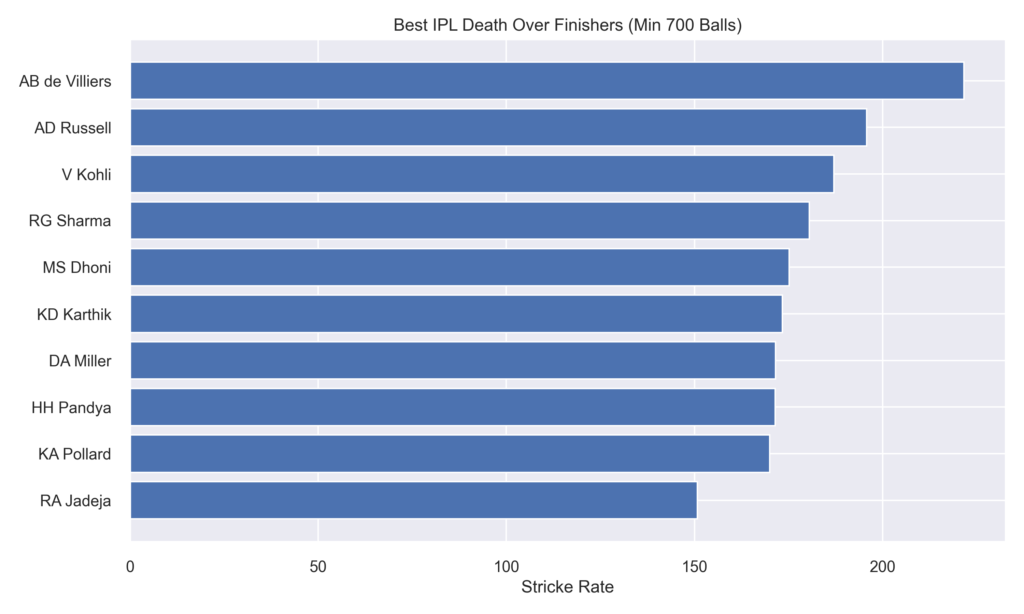
The graph of the best IPL finishers in death overs further strengthens this narrative by highlighting the players who have mastered this high-pressure phase. At the top of the list is AB de Villiers, whose exceptional strike rate sets him apart as one of the most impactful finishers in IPL history. Close behind is Andre Russell, known for his ability to change the course of a match within a few deliveries. What stands out in this graph is not just the presence of traditional finishers but also top-order players like Virat Kohli and Rohit Sharma, who have adapted their game to perform effectively in the death overs.
This shift indicates that finishing is no longer a role reserved only for lower-order batters. It has become an essential skill across the batting lineup. Players like MS Dhoni, Dinesh Karthik, and David Miller continue to demonstrate the importance of composure and decision-making in pressure situations, while all-rounders like Hardik Pandya and Kieron Pollard bring a combination of power and flexibility. The inclusion of players like Ravindra Jadeja also shows how adaptability and continuous improvement can redefine a player’s role. Overall, the graph highlights that successful finishing in the IPL requires not just power but also consistency, awareness, and the ability to perform under pressure.
3. Best Death Over Bowlers (Overall)
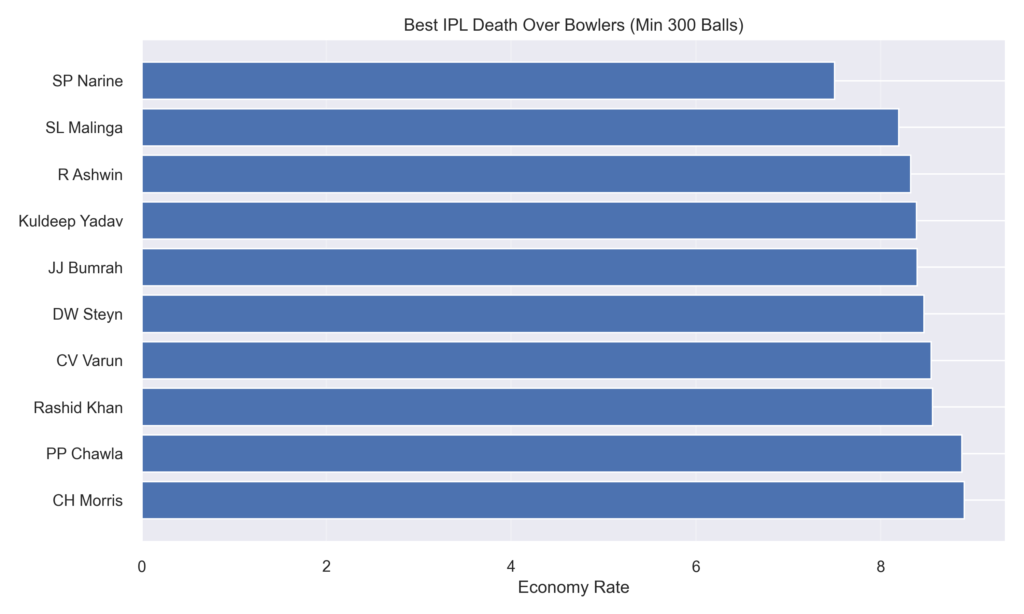
While batting has seen significant growth, the graph of best death over bowlers overall provides an interesting contrast by showing how difficult it has become for bowlers to maintain control in this phase. Sunil Narine stands out with the lowest economy rate, which is particularly impressive given the challenging nature of death overs. Close behind are Lasith Malinga and Jasprit Bumrah, both of whom are widely regarded as specialists in this phase due to their ability to execute yorkers, variations, and disciplined lines under pressure.
The presence of bowlers like Ravichandran Ashwin and Kuldeep Yadav also suggests that spin can be effective when used strategically, even in the final overs. At the same time, players like Dale Steyn, Rashid Khan, and Chris Morris highlight the importance of variation and adaptability. However, what this graph ultimately reveals is that even the best bowlers concede runs at a relatively high rate in the death overs. Unlike earlier phases of the game, success here is not about complete control but about minimizing damage and handling pressure effectively.
4. Best Death Over Bowlers by Season (2008-2025)
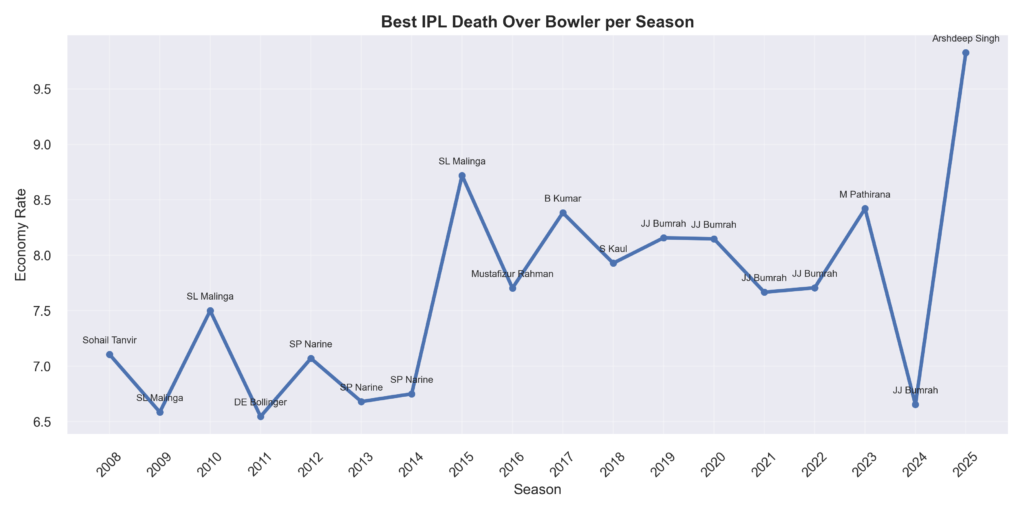
The final graph, which shows the best death over bowler by season from 2008 to 2025, provides a deeper understanding of how this challenge has evolved. In the early years, bowlers like Sohail Tanvir, Lasith Malinga, and Doug Bollinger were able to maintain economy rates between 6 and 7, indicating that controlling runs in the death overs was more achievable. These performances reflect a period where bowling still had a strong influence on this phase of the game.
However, as we move forward in the timeline, the graph shows a gradual increase in economy rates even for the best-performing bowlers each season. From around 2015 onwards, these values start moving closer to 8 and beyond, highlighting the growing dominance of batting. Players like Bhuvneshwar Kumar, Jasprit Bumrah, and Mustafizur Rahman continue to perform consistently, but the overall difficulty of the role becomes more evident. In recent seasons, this trend has become even more pronounced, with the 2025 season showing Arshdeep Singh’s economy rate nearing 10, which clearly indicates how challenging it has become to bowl in the death overs in modern IPL.
In conclusion, the analysis of these four graphs together presents a clear and consistent story about the evolution of death overs in the IPL. The steady rise in run rates, the emergence of highly skilled finishers, and the increasing difficulty faced by bowlers all point towards a game that is becoming more batting-dominated in its final phase. Death overs have transformed from a controlled finishing stage into the most explosive and decisive part of the match. Teams that excel in this phase gain a significant advantage, making it a key factor in determining success in the IPL. As the league continues to evolve, it is likely that this trend will continue, further emphasizing the importance of finishing strength and strategic execution in the last five overs.