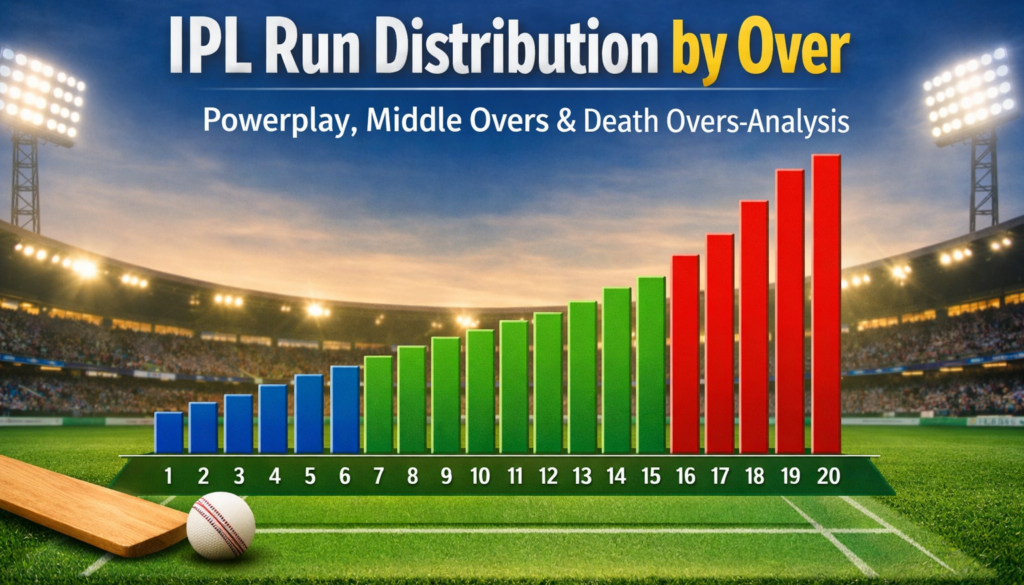
IPL Run Distribution by Over (2008–2025): Powerplay, Middle Overs & Death Overs Analysis
In T20 cricket, an innings rarely unfolds at a constant pace. The first few overs often involve calculated aggression as batters try to take advantage of fielding restrictions, while the middle overs can become a tactical battle between risk and stability. As the innings approach their final stages, the tempo usually rises dramatically, with teams aiming to maximize every ball and push the scoring rate as high as possible.
The Indian Premier League (IPL) has produced some of the most explosive batting performances in modern cricket. But does scoring truly accelerate toward the end of the innings? And which overs contribute the most runs? By examining scoring patterns across the 20 overs of an IPL innings, we can uncover how the rhythm of a T20 innings evolves and identify the phases that often shape matches.
A typical T20 innings can be divided into three distinct phases:
Powerplay (Overs 1–6): Fielding restrictions allow only two fielders outside the circle, encouraging aggressive batting.
Middle Overs (Overs 7–15): Teams often balance risk and stability while building the innings.
Death Overs (Overs 16–20): Batters attempt to maximize scoring with aggressive stroke play, often resulting in the highest run rates.
To understand how scoring develops during a T20 innings, the first step is to examine how runs are distributed across the 20 overs. Each over plays a different strategic role; the early overs allow aggressive batting due to field restrictions, the middle overs often involve controlled accumulation, and the final overs usually see explosive hitting as teams try to maximize their total.
The chart below shows the total runs scored in each over across all IPL matches from 2008 to 2025.
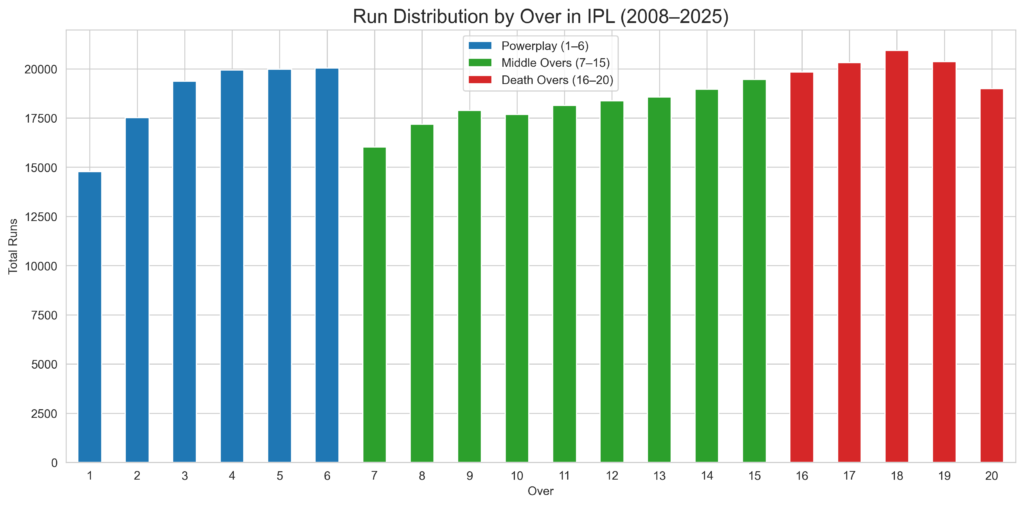
The distribution reveals a clear pattern. While scoring begins steadily during the powerplay overs, the most significant surge occurs in the final phase of the innings. Overs 16 to 20 produce the highest run totals, reflecting the aggressive batting strategies typically used during the death overs. Batters increasingly target the boundaries during this phase, leading to the innings’ highest-scoring overs.
While total runs provide an overall view of scoring distribution, they can sometimes be influenced by the number of matches or innings played. A more accurate measure of scoring intensity is the average runs scored in each over. This metric highlights how productive each over tends to be during an IPL innings.
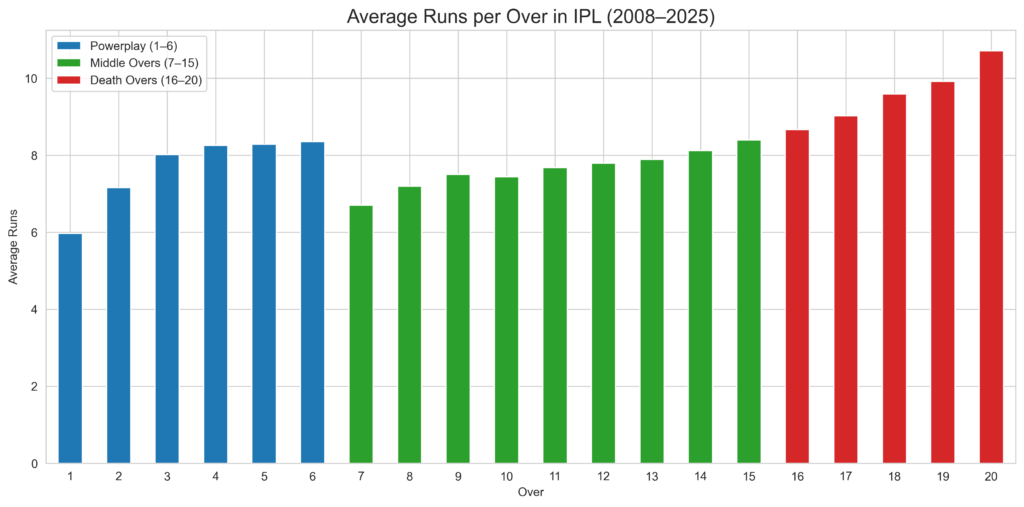
The average scoring rate increases gradually as the innings progress. Early overs show moderate scoring, followed by a relatively stable middle phase. However, the final overs demonstrate a sharp rise in run production, confirming the importance of the death overs in modern T20 cricket. Teams often rely on power hitters during this stage to accelerate the scoring rate dramatically.
To simplify the analysis further, the innings can be divided into three key phases: the powerplay (overs 1–6), the middle overs (7–15), and the death overs (16–20). Each phase carries different strategic objectives, influencing how teams approach their batting.
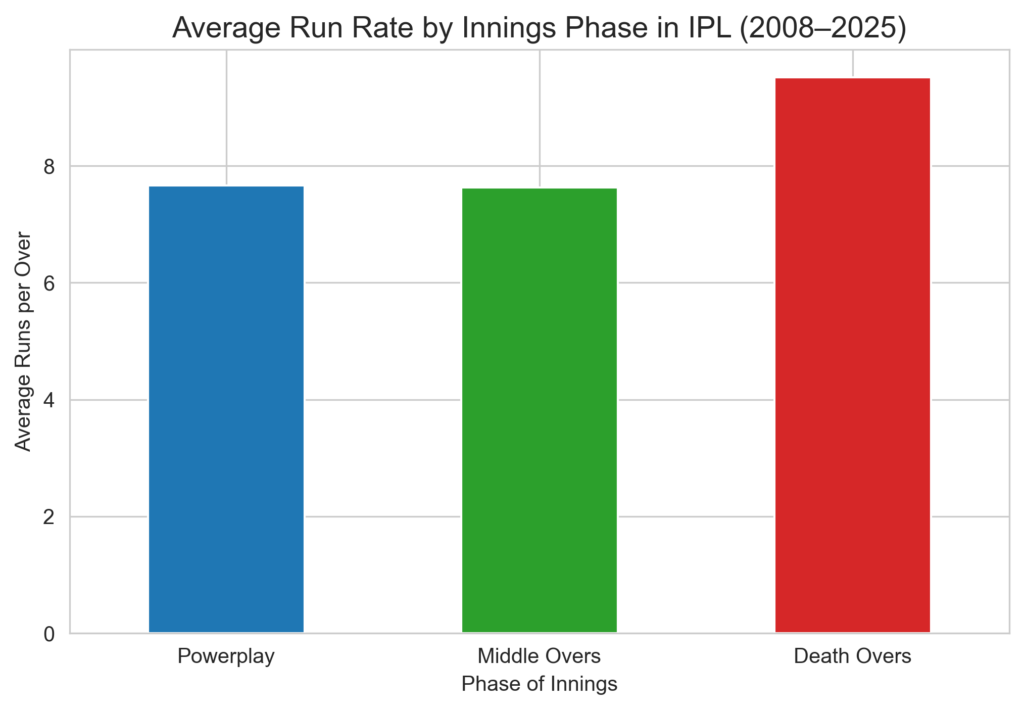
The phase-wise comparison clearly highlights how scoring intensity evolves during an innings. The powerplay allows teams to score freely due to fielding restrictions, while the middle overs typically involve a balance between maintaining wickets and building the innings. The death overs, however, stand out as the most aggressive phase, producing the highest run rate as batters attempt to finish the innings strongly.
Scoring patterns in T20 cricket are closely linked to wicket-taking patterns. Understanding when wickets fall during an innings provides additional insight into how teams manage risk and aggression throughout the match.
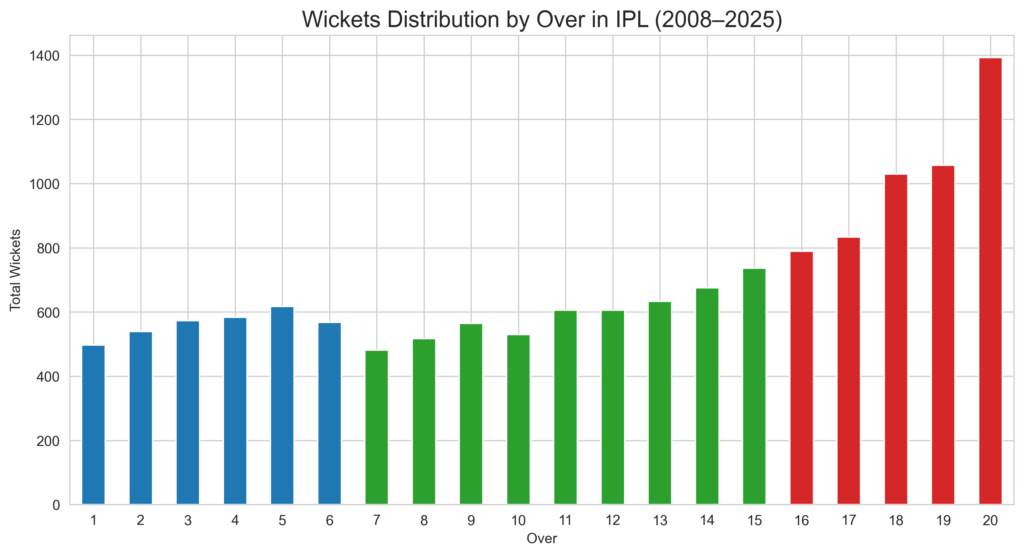
The wicket distribution shows that dismissals occur throughout the innings but tend to increase slightly during the later overs. This trend reflects the aggressive batting approach adopted during the death overs, where batters take greater risks to maximize scoring. While this strategy can produce high totals, it also increases the likelihood of losing wickets.
Conclusion
Overall, the analysis highlights a clear structure in IPL innings. Scoring begins steadily during the power play, stabilizes during the middle overs, and accelerates significantly in the final phase. The death overs emerge as the most decisive stage of an innings, where teams often gain or lose crucial momentum.
These patterns underline the importance of both explosive finishing and disciplined death-over bowling in modern T20 cricket. As the IPL continues to evolve, understanding these scoring dynamics can offer valuable insights into team strategies and match outcomes.