What is DRS in Cricket?
The Decision Review System (DRS) is a technology-assisted process used in cricket to assist match officials in making more accurate decisions. Its main purpose is to reduce human error in umpiring and ensure fair outcomes for both teams.
The system was formally introduced in Test cricket in 2008, later extended to One Day Internationals (ODIs) in 2011, and finally adopted in T20 Internationals in 2017.
DRS has significantly improved decision-making, especially in LBW appeals and caught-behind dismissals, making the game fairer and more transparent for players and spectators.
How DRS Works
When a player disagrees with an on-field umpire’s decision, a review can be requested under DRS. The on-field umpire then refers the decision to the third umpire, who examines it using available technological tools. Based on the evidence, the third umpire either confirms or overturns the original decision.
Components of DRS
Ball Tracking (Hawk-Eye)
Ball tracking is a visual technology that plots the trajectory of the ball from release to impact.
When the ball strikes the batsman’s pad, the system predicts whether the ball would have gone on to hit the stumps.
This technology is mainly used for LBW decisions and helps determine:
- Where the ball pitched
- Where it struck the batsman
- Whether it would have hit the stumps
UltraEdge / Snickometer
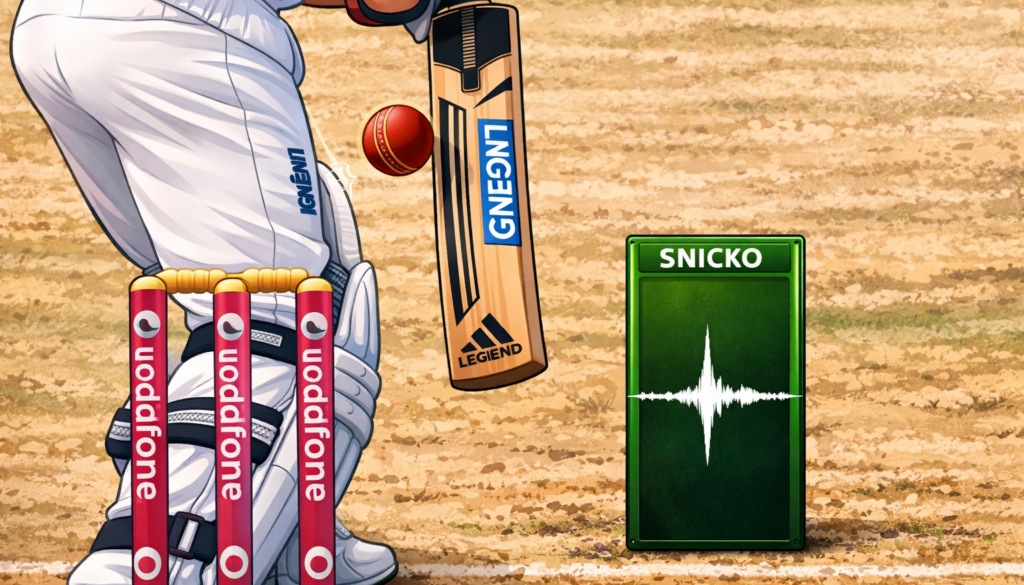
UltraEdge, also known as Real-Time Snicko (RTS), is an audio-based technology developed to detect faint edges between the bat and the ball.
In this, highly sensitive microphones placed around the pitch capture sound waves produced at the moment of contact. During a review, the third umpire studies the audio waveform to identify a sharp spike and checks its timing relative to the ball passing the bat.
In 2013, the traditional Snickometer was replaced by Real-Time Snicko, which is calibrated before the start of play each day. This removed the need for manual synchronisation and improved accuracy and reliability.
UltraEdge is especially useful in close caught-behind and LBW decisions.
Hot Spot Technology
Hot Spot is an infrared imaging system that detects heat generated when the ball makes contact with the bat or pad. The friction created at impact appears as a visible mark on the image, helping umpires identify faint edges.
While Hot Spot can be useful, it has limitations:
- Very faint edges may not generate enough heat
- Accuracy can be affected by bat coverings, temperature, and camera angle
- It is expensive and not available in all matches
For these reasons, Hot Spot is usually treated as supporting evidence, not standalone proof.
Umpire’s Call
Umpire’s Call is a concept within DRS used for very close LBW decisions, where technology cannot provide a completely conclusive result. It exists to account for the margin of error in ball-tracking technology and to respect the original on-field umpire’s judgment in borderline cases.
Key Factors in an LBW Decision
Every LBW decision is judged on three key elements:
- Pitching – Where the ball pitched (in line with the stumps, outside off, or outside leg)
- Impact – Where the ball struck the batsman and whether it hit the bat or glove first
- Wicket – Whether the ball would have gone on to hit the stumps
When the Umpire’s Call Applies
Umpire’s Call comes into play during a review when the decision is extremely close, mainly when:
- Less than 50% of the ball is shown to be in line with the stumps at impact, or
- Less than 50% of the ball is projected to hit the stumps (horizontally or vertically)
In such cases, the on-field decision stands, whether it is out or not out.
When the Umpire’s Call Does Not Apply
If it is clearly established that the ball hit the bat or glove holding the bat before hitting the pad. In such cases, the batsman cannot be given out LBW, and ball-tracking or Umpire’s Call becomes irrelevant.
DRS Review Process (Step-by-Step)
- A player disagrees with an on-field umpire’s decision
- The batsman on strike or the fielding captain requests a review
- The player signals by making a “T” shape with both hands
- The request must be made within 15 seconds
- The on-field umpire refers the decision to the third umpire
- The third umpire checks no-ball replays, Ultra-Edge, and ball tracking
- Based on the evidence, the original decision is either upheld or overturned
The DRS Timer Rule
Once the on-field umpire gives a decision, players have 15 seconds to decide whether to take a review. The countdown begins immediately after the decision is made.
If the review signal is not given within this time, the chance to challenge the decision is lost—even if later replays suggest the call was incorrect. This rule helps maintain the flow of the game and prevents unnecessary delays.
DRS Rules by Format
Although DRS works in the same basic way across all formats, the number of reviews allowed varies to suit the nature of each format.
DRS in Test Cricket
Test cricket allows the most flexible use of DRS because of its longer duration.
- Each team gets two unsuccessful reviews per innings
- After 80 overs, the review count is reset to two again
- Successful reviews and Umpire’s Call decisions do not count against the limit
This means a team can potentially have up to four unsuccessful reviews in one innings.
DRS in ODI Cricket
Because ODIs are shorter, the use of DRS is more restricted.
- Each team gets two unsuccessful reviews per innings
- Successful reviews are retained
Teams must use reviews carefully, as wasting one early can be costly.
DRS in T20 Cricket
T20 cricket is fast-paced, so reviews are limited to avoid disruption.
- Each team gets two unsuccessful reviews per innings
- Successful reviews are retained
Reviews are usually taken only for clear and confident challenges.
Conclusion
The variation in DRS rules across formats ensures a balance between accuracy and game flow. While technology helps correct obvious errors, the system is designed to support umpires—not replace them—preserving the human element of the game.